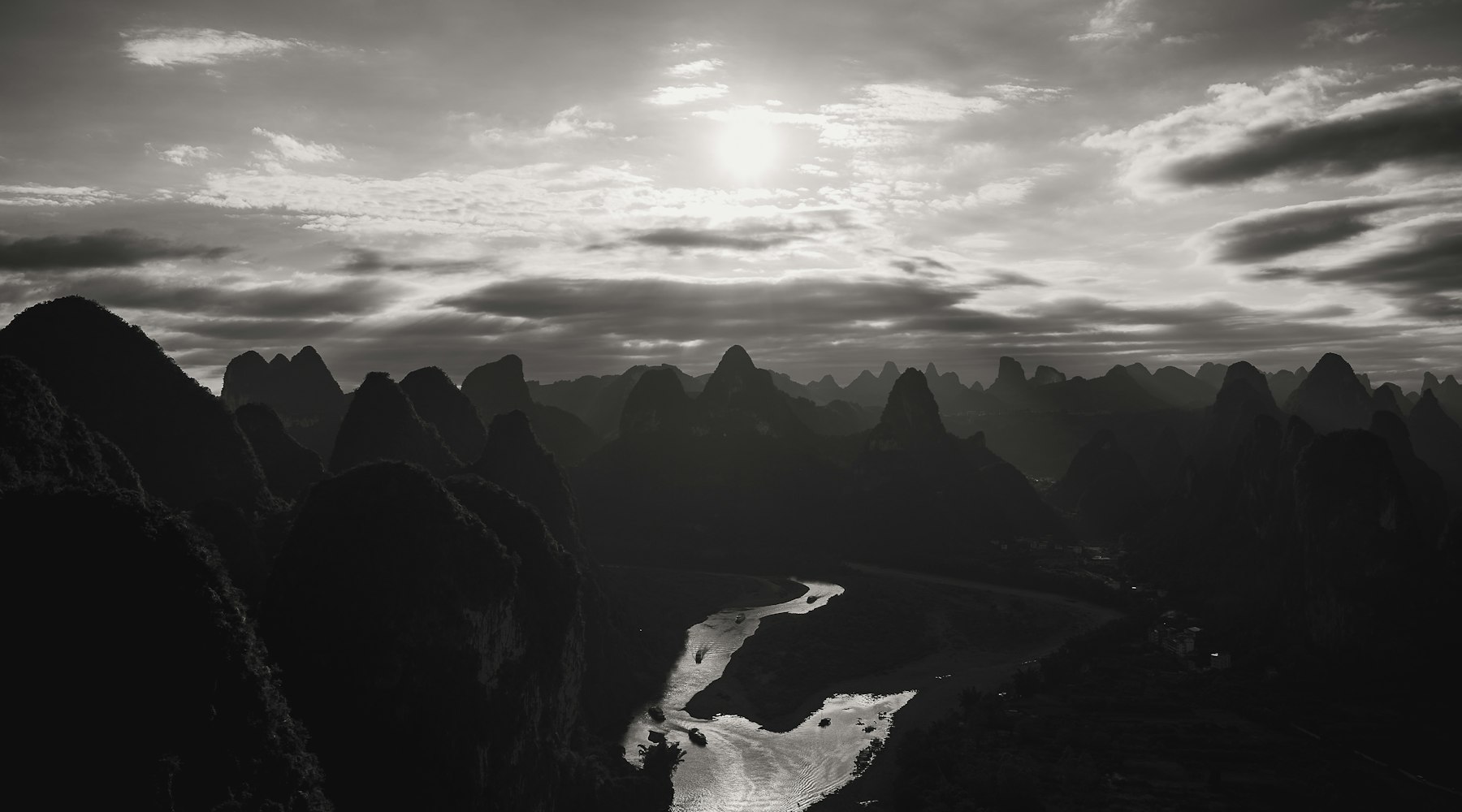
A fire stem at the edge of Li
The stems ride between the branches, and Ding sits between Wu, the horse, and Wei, the goat. It shares the fire of Li with Bing and Wu, but it is the quieter, inward fire, and it is the border: 202.5 ends Ding and Li at once. Past that line the reading is no longer fire but the earth of Wei.
The character Ding also means a person, the sons of a house. Old masters liked a fine peak on Ding for that reason, and the six xiu keep it there. Read it as a quality of the hill, not a count of children.
Ding as peak, facing and sitting, under Heaven's Pillar
Ding is valued most as a sha peak. From the site, a hill on 195 that stands upright, round-topped and well fleshed is what the six xiu mean. Its star is Tianzhu, Heaven's Pillar, an ordinary star named for support, something to lean on. Here the pillar is a check on the eye: if the peak looks like something the site can lean on, the sky agrees; if it is thin, broken or leaning away, the name adds nothing.
Sitting on Gui and facing Ding puts that pillar in front; sitting on Ding and facing Gui puts it behind as backing. Water from Ding should cross the front, not run straight at the stone.
What this means on the ground
Stand in the doorway with your back to the door, or behind the stone along its face, read three times, keep the middle number, keep steel away. Then sight across the dial to the south-south-west and see what stands there.
Inside the mountain, 187.5 to about 193 leans to Wu; 197 to 202.5 leans to Wei and earth; the middle band is clean Ding. For a peak, shape and distance count: a near hill that rises cleanly above the skyline on 195 is a true Ding peak. A ridge that merely passes through 195 on its way elsewhere is not.
Common mistakes
The first is a true-north bearing called Ding. With a declination of twelve degrees west, a real Ding reading of 195 shows as 207, which is Wei. The second is sitting a stone on 202.5, the line between fire and earth, where the fen jin should have moved it. The third is a Ding hill found on a map that, from the site itself, is hidden or barely a bump.
The fourth is treating six xiu as a verdict. Ding is on the list because a good peak there is worth having; the list says nothing in favour of a bad one.
Questions people ask
What direction is Ding on a feng shui compass?
South-south-west, 195 degrees magnetic, from 187.5 to 202.5. Ding is a heavenly stem of fire, the last mountain of the Li trigram after Bing and Wu, and its opposite is Gui at 15 degrees.
Why is a Ding peak considered good in feng shui?
Ding is one of the six xiu, the six mountains where a fine peak is prized. A hill on 195 that stands upright and full, seen from the site, is read as backing and support. The value is in the hill's shape; a poor hill on Ding is still poor.
Which star is on Ding mountain?
Tianzhu, Heaven's Pillar. Its name means support and something to lean on. It is an ordinary star, and the Tianxing school uses it to confirm a solid peak or backing on Ding rather than to add luck to the direction.
If a hill stands to the south-south-west of your plot or your family stone, send its photo and your readings and Master Zhang will tell you in a site reading whether it is a true Ding peak.