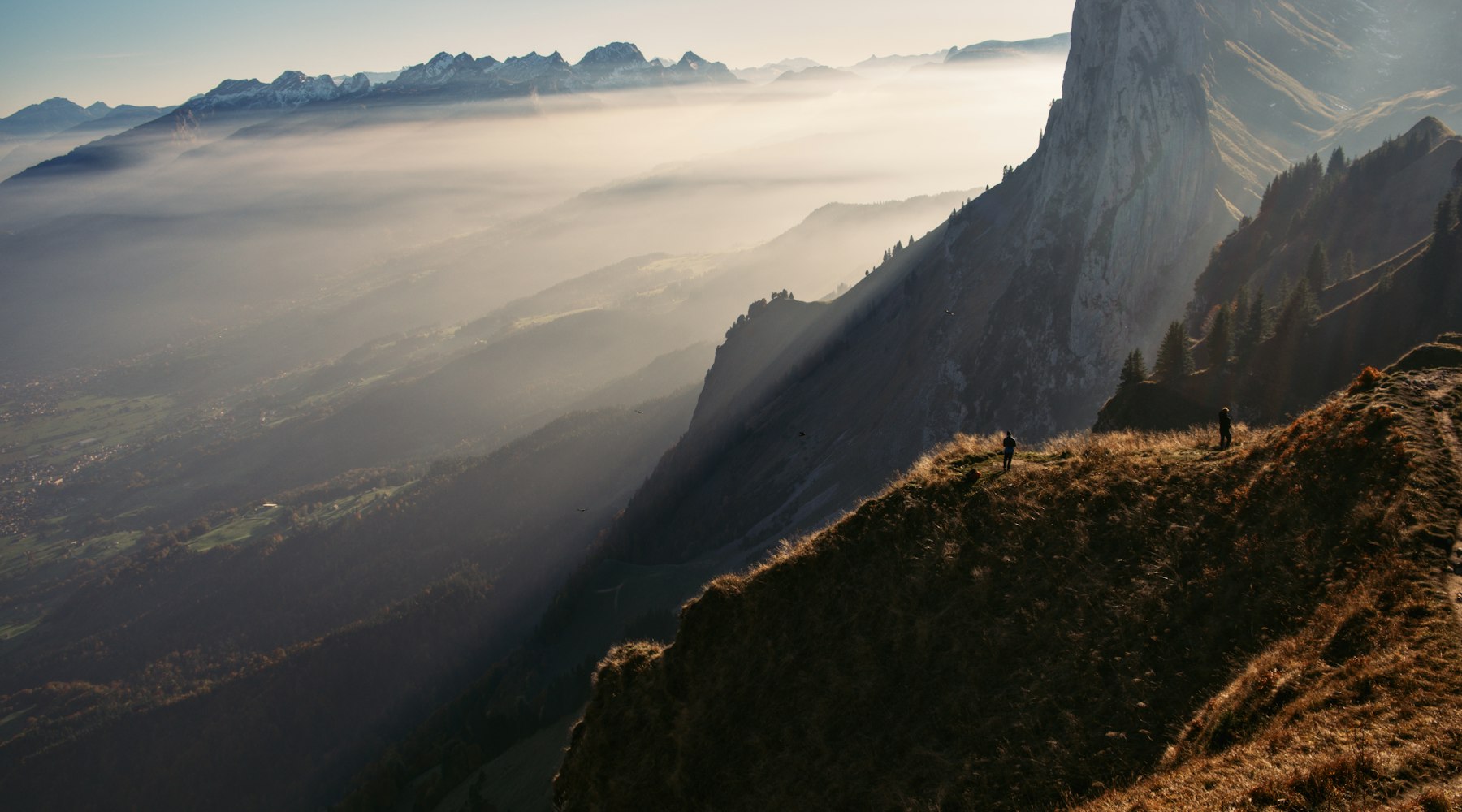
The five positions: dragon, tiger, table, facing, support
Stand on the site facing outward. The hill on your left is the green dragon, qing long. The hill on your right is the white tiger, bai hu. The low hill directly in front is the table hill, an shan. The higher peak beyond it, further off, is the facing hill, chao shan. Behind the site, the small rise that props it up is the gui or le, the ghost or the support. Not every site has all five. A good site has the left and right arms, something low in front, and something firm behind.
Embrace, turned back, and pointing
Embrace, huan bao, is the shape you want. The left and right hills curve inward so their ends almost meet in front of the site, the way two arms close around a child. The ground between them is calm and the water drains slowly across it.
A hill that turns its back, fan bei, bulges away from the site. Its convex side faces you, its concave side faces somewhere else. It is sheltering another place, not yours. A hill that points, jian she, sends a sharp spur or ridge end straight at the site. Both are rejected in the form school, however close or green they look.
What this means on the ground
For a grave, stand at the proposed headstone and turn slowly. Left arm, right arm, table in front, support behind. The arms should be lower than the parent hill behind you and roughly matched in height. If either arm is missing, feel for wind. A plot the wind crosses freely is exposed.
For a house, neighbouring buildings play the part of hills. A taller block on the left and a lower one on the right is the classic arrangement. A shop wants a low, clean table in front: an open forecourt or a modest building across the road, not a tower.
Common mistakes
The most common mistake is to call any nearby hill protection. A hill is sha only if it relates to the site: it curves toward it, sits at the right height, and closes a gap. A hill that is simply there is scenery.
The second is to prefer big over fitting. A tiger that overtops the dragon and crowds the site is a fault, not a strength.
The third is to read sha without the compass. Form comes first, but the Tianxing school then checks where each peak sits on the twenty-four mountains. A fine peak on a noble star mountain such as Hai or Xun is worth more than the same peak on an ordinary one.
Questions people ask
What are the green dragon and white tiger in feng shui?
The hills on the left and right of a site, seen facing outward: left is the green dragon, right the white tiger. They should curve inward and shelter the site.
What is the table mountain (an shan)?
The low hill directly in front of a site, about desk height seen from the site. It holds the water in and stops the view running away.
Do buildings count as sha for a house or shop?
Yes. In a city, neighbouring buildings take the place of hills and follow the same rules: taller on the left, lower on the right, low and clean in front.
If you cannot tell whether the hills around your plot embrace it or turn away, send us the location for a site reading, or learn to see it yourself on the field course.